Choosing the best Ukuleles for global sourcing requires more than comparing prices and polished product photos. Buyers must examine tonewood, neck stability, fret accuracy, finish quality, and production consistency. A low-cost sample may sound pleasant today, yet develop buzzing frets after weeks of changing humidity. That detail matters when instruments travel between tropical factories, dry warehouses, and retail shelves.
Jake Shimabukuro, a respected ukulele performer and educator, once said, “The ukulele is a happy instrument.” Its cheerful character attracts beginners, schools, musicians, and gift buyers worldwide. However, happiness should not replace careful evaluation. A reliable sourcing process should include several samples from different production batches. Test each instrument for tuning stability, clean intonation, comfortable action, and even volume across the strings. Check the bridge alignment and inspect the inside of the body with a small light. These simple steps can reveal careless assembly.
Material documentation also deserves attention. Ask suppliers about wood species, factory quality controls, packaging tests, and replacement procedures. Confirm that labels, claims, and shipping documents meet the destination market’s requirements. Do not assume every attractive factory page reflects current production ability. Some details may remain unclear.
There is no universal best choice. A concert Ukulele may suit professional players, while a soprano model may serve classrooms and travel retailers better. Even experienced buyers can misjudge a supplier after one successful order. This guide explores practical comparisons, supplier questions, sample testing, and cost decisions. It also considers the uncomfortable gaps between a perfect prototype and dependable mass production.
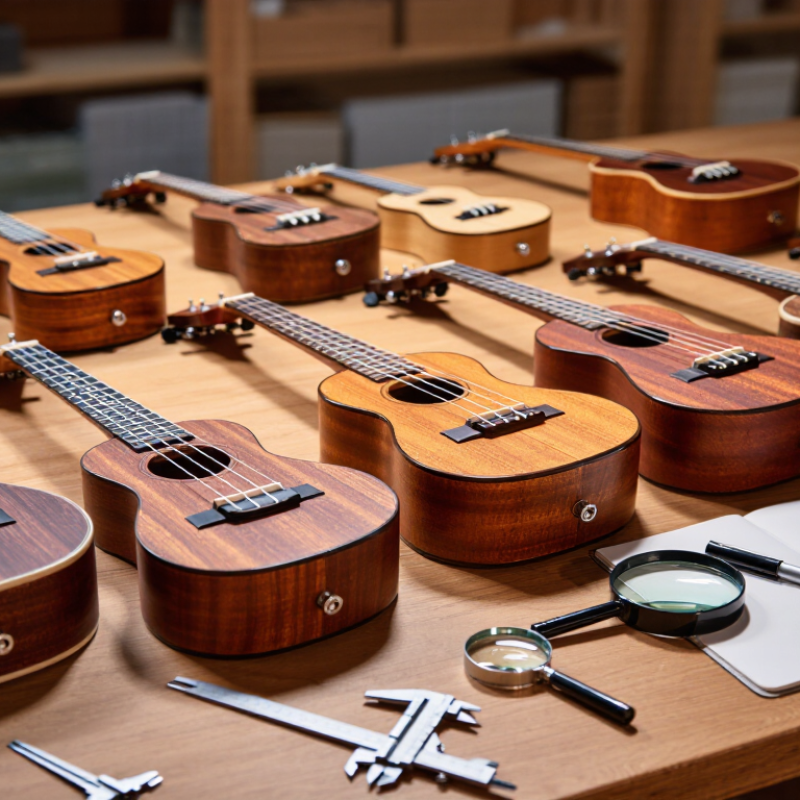
A strong global sourcing brief starts with measurable specifications, not attractive photographs. For ukuleles, define a 21–30-inch scale range and G–C–E–A tuning clearly. Scale length means the distance from the nut to the saddle, not the instrument’s total length. Ask suppliers to state both measurements. A 21-inch scale feels compact and suits younger players or frequent travel. A 30-inch scale provides more room for larger hands and a fuller response. These differences affect comfort, tone, packaging, and shipping costs.
For consistent purchasing, include neck width, fret count, string height, body dimensions, wood type, finish, and target weight. Specify whether G–C–E–A uses high-G or low-G setup. The difference changes the playing feel and must appear on the purchase specification. Request a physical sample before approving production. Check tuning stability after several hours, fret sharpness, bridge alignment, and intonation at the 12th fret. Small errors become audible.
Reliable sourcing also requires a written inspection plan. Set acceptable limits for cosmetic marks, loose hardware, uneven frets, and finish defects. Record moisture readings for wooden parts before shipment, especially when products cross climate zones. Packaging should protect the bridge and tuning machines from pressure. Do not trust photos alone. In my own briefs, I once focused too heavily on appearance and underestimated setup consistency. That mistake taught me to compare samples under the same strings, tuning, and room conditions. The brief will never be perfect, but clear testing makes revisions more honest.
When sourcing ukuleles globally, tonewood selection should begin with density, not appearance. In factory evaluations, I tap sample tops, weigh bodies, and record moisture before judging tone. Dense woods often produce a focused attack and strong sustain. Lighter woods can respond quickly, with a softer, more open character. These are tendencies, not guarantees. Grain direction, thickness, bracing, and finish can change the result.
Spruce usually offers clear projection and sensitive response, but its lighter surface can show dents during warehouse handling. Mahogany often balances warmth, moderate density, and dependable workability. Maple tends to sound firm and articulate, while heavier walnut can add sustain without sounding excessively bright. Species labels alone are insufficient. Ask suppliers for scientific names, density ranges, moisture readings, and samples from the intended production batch. A sample that sounds excellent in a quiet room may lose detail in a busy retail environment.
Durability also depends on humidity control, neck joints, end-grain sealing, and packaging. I would test finished instruments after controlled humidity cycling, then inspect fret movement, cracks, and tuning stability. Results can be untidy. Two pieces from one species may behave differently. That is why I prefer measured comparisons over attractive grain photos. Confirm lawful harvest documentation and consistent grading before placing a large order. Cost matters, but replacement rates, returns, and freight damage matter more. Even experienced buyers can misjudge a first sample.
| Tonewood | Typical Air-Dry Density (g/cm³) |
Approx. Janka Hardness (lbf) |
Durability and Handling | Acoustic Response | Typical Ukulele Application | Global Sourcing Considerations | Procurement Fit |
|---|---|---|---|---|---|---|---|
| Sitka Spruce | 0.35–0.45 | 510 | Lightweight with good strength-to-weight performance. Softer than hardwoods, so the surface can dent or scratch more easily. | Clear, articulate, responsive, and well balanced. Produces strong projection with noticeable high-frequency detail. | Soundboards for bright, projecting instruments. | Usually consistent in grading and widely used in acoustic instruments. Requires protection from impact and excess humidity during transport. | Strong for projection |
| Western Red Cedar | 0.32–0.45 | 350 | Very light and easy to work, but relatively soft. More vulnerable to dents, compression marks, and handling damage. | Warm, quick, and expressive response. Often emphasizes strong fundamental notes and a smooth, rounded character. | Soundboards for fingerstyle, soft attack, and warm tonal designs. | Low weight can reduce shipping mass, but packaging and final inspection should address denting and surface pressure. | Strong for warmth |
| Mahogany | 0.45–0.65 | 800–1,000 | Moderately hard, stable, and comparatively easy to machine. Offers a practical balance between durability and workability. | Warm, focused, and even, with a controlled midrange and moderate sustain. | Soundboards, backs, sides, and necks; suitable for balanced all-purpose models. | Confirm the exact botanical species and legal documentation because “mahogany” can refer to different woods with different trade requirements. | Best all-round balance |
| Maple | 0.55–0.75 | 1,450–1,450+ | Hard, wear-resistant, and suitable for components exposed to frequent handling. Heavier than spruce or cedar. | Bright, clean, and focused, with strong note separation and relatively restrained overtone coloration. | Backs, sides, necks, and decorative components where clarity and visual figure are desired. | Higher density increases shipping weight. Curly, flamed, or figured grades may have greater sorting and yield costs. | Strong for clarity |
| Koa | 0.55–0.75 | 1,170 | Moderately hard and stable when properly seasoned. Figured pieces may require more careful machining to reduce tear-out. | Balanced and clear, often combining warm midrange character with articulate upper frequencies. | Backs, sides, and complete bodies for premium visual and tonal positioning. | Supply can be limited and grade-dependent. Verify harvest legality, origin documentation, and consistent availability before committing to volume. | Premium differentiation |
| Walnut | 0.55–0.70 | 1,010 | Moderately hard with good dimensional stability and practical machinability. Provides better dent resistance than softer soundboard woods. | Warm but articulate, with a balanced bass response and clear upper-mid detail. | Backs and sides for instruments requiring visual contrast and a controlled, balanced sound. | Often available in several grades. Color variation should be defined in the purchase specification to control batch consistency. | Strong for balanced designs |
| Rosewood | 0.80–1.05 | 1,780–2,790 | Very hard and wear-resistant, but heavy and more demanding to machine. Fine dust requires appropriate workplace controls. | Strong sustain, pronounced overtone content, and a powerful low end with clear high-frequency detail. | Fingerboards, bridges, backs, and sides in higher-specification instruments. | Species identification and international trade documentation are critical. Some rosewood species are regulated under CITES and may require permits. | Premium tone and durability |
| Sapele | 0.60–0.75 | 1,410 | Hard and reasonably durable, with good resistance to everyday wear. Interlocked grain can increase machining difficulty. | Bright to warm-balanced, with good projection and a focused midrange. | Backs, sides, and necks for durable, cost-conscious alternatives to some mahogany designs. | Check species naming, source region, chain-of-custody documentation, and batch moisture consistency. | Strong value option |
| Basswood | 0.32–0.42 | 410 | Very light and easy to shape, but soft and more susceptible to dents and compression damage. | Neutral, soft, and relatively even, with moderate projection and less pronounced overtone complexity. | Entry-level bodies, painted finishes, and lightweight product lines. | Low density helps reduce shipping weight and material cost. Protective finishing and packaging are important for retail durability. | Strong for lightweight value |
How to Choose the Best Ukuleles for Global Sourcing?
Construction quality begins with the wood, not the finish. A solid spruce, mahogany, or koa top usually produces stronger projection and richer overtones. It also reacts more noticeably to climate changes. Laminate bodies offer steadier performance and often reduce sourcing risk. They can resist small dents better, but their tone may sound flatter. The USDA Forest Products Laboratory’s Wood Handbook (2021) notes that indoor wood often reaches 6–14% equilibrium moisture content, depending on climate. Ask suppliers for kiln-drying records and moisture readings. I would reject samples above this range without further testing. Perhaps too quickly.
The 12th-fret action deserves a gauge, not a casual glance. For many soprano and concert models, 2.5–3.5 millimeters is a practical inspection range. Excessive height makes beginner chords tiring. Very low action can create buzzing during humid storage or transport. Measure both outer strings and the center strings. Check neck relief, fret leveling, saddle fit, and bridge adhesion under normal string tension. The 2024 Mordor Intelligence Ukulele Market report projects continued market growth through 2029, increasing pressure on suppliers to deliver consistent batches. Request measurements from at least ten units, not one perfect sample. My own mistake was trusting a polished prototype. Production variation told a different story.
Assess construction quality through solid tops, laminate bodies, and 12th-fret action.
A solid spruce, cedar, or mahogany top can provide more acoustic complexity, but it requires consistent grain selection, bracing, humidity control, and finishing.
Laminate construction is generally more resistant to humidity changes and is often suitable for cost-efficient global sourcing and stable production.
The chart shows commonly used setup benchmarks. Lower action can feel easier to play, while excessive action may indicate nut, saddle, neck-angle, or fretwork issues.
Benchmark values are approximate setup targets in millimetres and should be validated against the supplier’s neck geometry, fretwork, string tension, and final inspection standards.
When sourcing ukuleles globally, factory claims need measurable proof. An AQL 1.5 inspection creates a practical sampling benchmark for production lots. An inspector selects units using an agreed sampling plan, then checks appearance, construction, hardware, packaging, and playability. Critical safety issues should have zero acceptance. Major and minor defects follow separately defined limits. AQL 1.5 is not a promise of perfection. It is a controlled risk decision.
Tuning needs equal discipline. Test each sampled ukulele at 440 Hz with a calibrated electronic tuner, not by ear alone. Check open strings, octave notes, and basic chords. Record pitch drift after five minutes of playing.
Fresh strings can settle, so retesting matters. Look for loose tuners, high action, buzzing frets, and uneven bridges. A factory that shares dated inspection records is easier to evaluate.
Ask for defect photos, batch numbers, corrective-action reports, and retest results. Compare pre-shipment findings with arrival inspections. This reveals whether the factory fixes root causes or only replaces visible units. In my experience, packaging damage often hides weak carton design, not careless shipping. One useful lesson is uncomfortable: a passing sample can still miss a poor batch. Keep supplier scores, sample conditions, and tuning results together. Review them before every repeat order.
Choosing the best ukulele for global sourcing requires more than comparing tonewoods and factory prices. Confirm the exact wood species before ordering samples. CITES documents may be required for protected materials and international shipments. FSC certification can support responsible forestry claims, but verify the certificate and product scope. Do not accept a logo alone. Ask for current records.
Check REACH requirements for European sales, especially coatings, adhesives, dyes, and metal parts. CPSIA may apply to products intended for children in the United States, including testing and documentation. Requirements can change by market. Ask a qualified compliance laboratory to review the finished ukulele, not only its raw materials. A missing test report can delay an otherwise ready shipment.
Tips: Put MOQ, sample approval, production lead time, packaging details, and inspection points in writing. Calculate landed cost carefully. Include unit price, tooling, testing, freight, insurance, duties, customs fees, and local delivery. A low quotation can become expensive at the warehouse. Request a production sample and inspect fret edges, tuning stability, finish consistency, and carton strength.
My practical warning is simple: supplier promises are useful, but documented evidence is safer. Allow buffer time; even a good plan can fail during peak shipping periods.
State the 21–30-inch scale range clearly. Scale length runs from the nut to the saddle. It is not the instrument’s total length. Request both measurements from suppliers. A 21-inch scale suits travel and younger players. A 30-inch scale offers more room for larger hands.
Specify G–C–E–A tuning and identify high-G or low-G setup. These options feel noticeably different. Check tuning stability after several hours. Test open strings, octave notes, and basic chords. Use a calibrated tuner set to 440 Hz.
Request neck width, fret count, string height, and body dimensions. Include wood type, finish, and target weight. Ask suppliers to confirm bridge alignment and 12th-fret intonation. Small setup errors become audible quickly. Photos cannot show every problem.
Compare density, moisture, durability, and acoustic response. Weigh the bodies and tap sample tops. Lighter woods may respond quickly and sound open. Denser woods often provide stronger attack and sustain. These are tendencies, not guarantees. Construction details can change the result.
Request scientific names, density ranges, moisture readings, and production-batch samples. Confirm lawful harvesting documentation and consistent grading. Grain photographs are not enough. Two pieces from one species may behave differently. That part is easy to underestimate.
Compare samples using identical strings, tuning, and room conditions. Inspect fret sharpness, bridge position, finish quality, and hardware. Play the instrument for several hours. Retest tuning after five minutes of playing. Fresh strings may settle. Retest anyway.
AQL 1.5 provides a sampling benchmark for production lots. It does not guarantee perfect instruments. Inspectors check appearance, construction, hardware, packaging, and playability. Separate critical, major, and minor defects. Critical safety issues should have zero acceptance. Risk remains.
Protect the bridge and tuning machines from pressure. Inspect carton strength and internal padding. Record moisture readings before shipment. Climate changes can affect wooden parts. Packaging damage may reveal weak carton design, not careless handling. I once focused too much on appearance. That was a costly lesson.
Choosing the best Ukuleles for global sourcing begins with a clear sourcing brief. Define the target size, typically a 21–30-inch scale, and require standard G–C–E–A tuning to ensure consistency across production. Evaluate tonewoods according to density, durability, sustainability, and acoustic response, while comparing solid tops with laminate bodies based on the intended price and performance level. Construction quality should be checked through body alignment, fret finishing, neck stability, bridge security, and 12th-fret action.
Before placing an order, verify factory performance through AQL 1.5 inspections, accurate 440-Hz tuning, and documented quality-control procedures. Import requirements should also be confirmed, including CITES and FSC documentation for applicable woods, as well as REACH and CPSIA compliance where relevant. Finally, compare MOQ, lead time, packaging, shipping, duties, and other expenses to calculate the true landed cost. A structured evaluation helps buyers balance sound quality, reliability, compliance, and profitability.