Composite Case
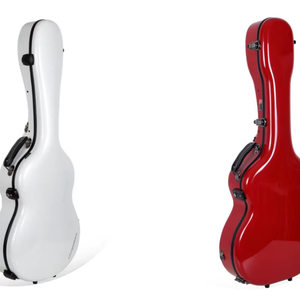
Every component within our carbon composite and instrument catalog is built under strict ISO-grade manufacturing protocols, delivering maximum structural integrity, resonance fidelity, and international export safety.
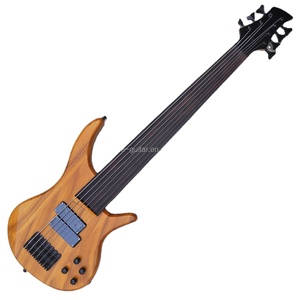
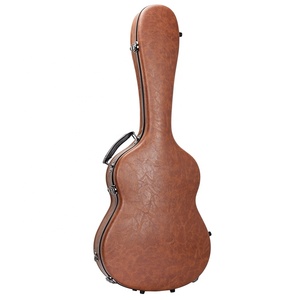
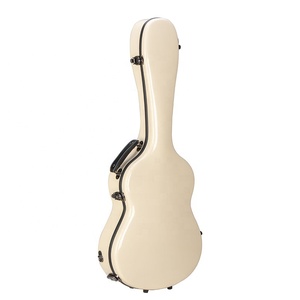
For more than three centuries, acoustic guitar manufacturing has been tied to traditional tonewoods such as Sitka Spruce, Western Red Cedar, Brazilian Rosewood, and African Mahogany. However, traditional wooden soundboards present inherent physical contradictions: they require delicate thickness to optimize the vibration velocity of soundwaves, yet must bear over 160 to 180 pounds of continuous string tension. This organic fragility creates warping, bellying behind the bridge, neck joint drift, and sound decay under atmospheric fluctuations.
As a specialized OEM/ODM carbon fiber guitar manufacturer and exporter, we leverage advanced composite material science to eliminate these structural compromises. Carbon fiber reinforced polymer (CFRP) features a specific stiffness-to-weight ratio that exceeds traditional spruce by more than 300%. The speed of sound propagation through high-modulus unidirectional carbon weaves reaches approximately 12,000 meters per second, compared to approximately 5,000 meters per second in premium quarter-sawn spruce.
"Through our multi-axial carbon fiber soundboard layups and honeycomb composite cores, we achieve higher acoustic impedance matching between string excitation and soundboard radiation, delivering unparalleled sustain, crystal-clear projection, and total structural stability."
By balancing 3K, 6K, and 12K cross-woven carbon fabrics with proprietary acoustic damping epoxy resins, our engineers fine-tune the internal damping factor (η) of the soundboard. This eliminates the harsh, brittle high-frequencies once associated with early experimental composite instruments, yielding an acoustic profile characterized by warm, resonant low-end presence, articulate midrange separation, and ringing harmonic overtones.
Traditional wood lutherie relies heavily on environmental stabilization rooms, manual wood bending, and vulnerable kerfing joints. In contrast, our industrial carbon fiber guitar OEM/ODM platform operates on precision aerospace composite fabrication technologies:
A. Monocoque One-Piece Molded Construction: Unlike wood guitars where the neck, heel, back, and sides are separate pieces held together with organic glues, our flagship carbon fiber instruments can be cured as a seamless monocoque body. This removes the acoustic energy loss typically found at the neck-to-body joint, allowing full vibration transfer from the headstock down through the lower bout.
B. High-Pressure Vacuum Autoclave Curing: Soundboards and bodies are cured under controlled thermal cycles and elevated atmospheric pressure in nitrogen-purged autoclaves. This process eliminates microscopic resin voids, ensuring exact density distribution and identical acoustic voicing across production runs of tens of thousands of units.
C. Resonant Honeycomb Core Sandwiches: We integrate aerospace-grade Nomex and PMI foam cores between ultra-thin structural carbon plies. This composite sandwich increases bending stiffness without adding unnecessary mass, enabling the soundboard to flex freely under delicate fingerpicking while resisting dynamic compression during aggressive flatpicking.
| Performance Metric | High-Modulus Carbon Fiber (CFRP) | Solid Sitka Spruce / Mahogany | Laminated Tonewood (HPL) |
|---|---|---|---|
| Tensile Strength (MPa) | 1,200 – 1,800 MPa | 80 – 110 MPa | 45 – 65 MPa |
| Relative Humidity Tolerance | 0% – 100% (No movement) | 40% – 55% (Vulnerable to cracking) | 30% – 70% (Delamination risk) |
| Thermal Expansion Coeff. | ∼ -0.1 × 10⁻⁶ / K | 30 – 50 × 10-6 / K | 25 – 40 × 10-6 / K |
| Acoustic Decay / Fatigue | Zero degradation over decades | Dries out, brittle, glue rot | Acoustic deadening over time |
| CITES Regulatory Compliance | 100% Exempt (Hassle-free export) | Restricted (Rosewood, Ebony, etc.) | Varies by inner timber species |
International musical instrument importers, brand curators, and multi-channel retailers are adjusting their supply chain priorities. Several structural industry trends are accelerating commercial orders for OEM/ODM carbon fiber guitars:
Strict CITES Environmental Enforcement: Global customs crackdowns on endangered timbers (such as Dalbergia rosewoods and protected tonewoods) make wooden instrument exports risky and administrative paperwork cumbersome. Carbon fiber guitars are entirely timber-free, requiring zero endangered botanical materials, which guarantees smooth cross-border clearance at international ports.
Direct-to-Consumer (DTC) E-Commerce Logistics: Traditional acoustic guitars frequently suffer transport damage, neck misalignments, and climate cracking during global parcel transit. Retail brands stocking carbon fiber guitars report near-zero return rates caused by humidity drop, bridge lifting, or temperature shock during intercontinental freight.
Expansion into Travel & Outdoor Lifestyle Demographics: Modern guitarists increasingly demand lifestyle portability. Carbon fiber travel guitars, parlor models, and composite ukuleles cater directly to outdoor touring, camping, beach performance, and extreme tropical or sub-zero climates where organic tonewoods fail.
Combining generations of stringed instrument heritage with aerospace composite facilities to provide seamless OEM/ODM services for distributors, musical groups, and retail giants worldwide.
Rooted in historic stringed craft reaching back to 1871 through our lineage with Oscar Schmidt and Washburn traditions, ensuring every composite mold honors classic playability, fret geometry, and balance.
Our composite acoustic lab analyzes modal frequencies using FFT (Fast Fourier Transform) laser interferometry, ensuring that every batch of OEM carbon fiber tops matches exact target resonance profiles.
From initial 3D CAD modeling, custom neck profilings, CNC molds, and pickup electronics integration to custom flight cases and branded retail packaging, we oversee your entire production cycle.
Instruments endure 72-hour thermal cycling (-20°C to +70°C), humidity saturation stress tests, and automated robotic string tensioning to guarantee zero post-sale structural failures.
Clear, technical answers to critical sourcing, compliance, tooling, and lead time questions for retail brands and bulk importers.
Partner with an industry-leading OEM/ODM manufacturer. From custom design files and sample validation to container-load production, our acoustic engineering team is ready to accelerate your brand's growth.
Send an Inquiry