Engineering Baritone Ukuleles for New Zealand’s Acoustic Market
A technical guide for musical instrument wholesalers, regional distributor networks, school consortiums, and boutique lutherie brands across Auckland, Wellington, and Christchurch.
1. The Emerging Dynamics of the New Zealand Ukulele Landscape
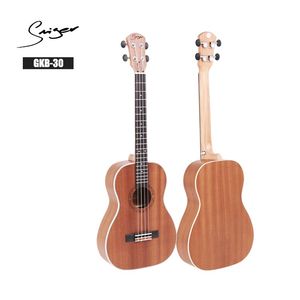
Over the last decade, the fretted instrument sector in Aotearoa New Zealand has experienced a pronounced structural maturation. Historically dominated by standard soprano and concert instruments driven by foundational school music programs, buyer intent data across New Zealand's musical retail landscape demonstrates a continuous pivot toward larger scale lengths. In particular, the 30-inch Baritone Ukulele (tuned D-G-B-E) has evolved from a niche curiosity into an essential stock-keeping unit for commercial distributors.
This growth is underpinned by demographic shifts in instrument usage. First, secondary school music curriculums across the North and South Islands are integrating the baritone ukulele as a bridge instrument between introductory classroom strummers and full-size acoustic guitars. Second, the prominent presence of Pasifika music cultures, contemporary indie folk bands, and vibrant community ukulele orchestras (such as those active in Auckland and Christchurch) has fostered strong consumer demand for rich, lower-register tonal projection. The baritone ukulele delivers the warm, resonant acoustic timbre required for multi-part arrangements, bridging the sonic gap without requiring musicians to adopt the heavier tension and complex chord fingerings of standard steel-string guitars.
Educational Bridging
Direct D-G-B-E linear tuning mirrors the top four strings of a classical or acoustic guitar, drastically steepening the learning curve for Kiwi students transitioning into advanced performance ensembles.
Maritime Climate Resilience
New Zealand’s hyper-humid coastal air demands rigorous conditioning. Our timber undergoes secondary dehumidification, locking wood moisture content between 8% and 11% to eliminate belly bellying and fret sprout.
High Retail Margin Density
With retail price points sitting comfortably between mid-tier tenors and full acoustic guitars, baritone instruments generate superior gross margin per cubic meter of shipping container space.
2. Climatic & Lutherie Engineering: Overcoming the Oceanic Barrier
Procuring acoustic fretted instruments for New Zealand distributors carries unique supply chain risks rooted in physical geography. The maritime conditions characteristic of New Zealand port cities—where ambient relative humidity often spikes above 75% in winter while dropping rapidly in centrally heated indoor spaces—can trigger devastating structural failures in poorly processed wooden instruments. Common issues include soundboard warping, glue line shear along the bridge perimeter, neck relief instability, and razor-sharp fret ends (fret sprout).
To insulate our New Zealand brand partners against warranty returns, our manufacturing facility operates dedicated microclimate environmental chambers. Tonewood billets (including Asian Mahogany, African Sapele, and East Indian Rosewood alternatives) are stabilized through a multi-stage kiln drying and seasoning regimen lasting a minimum of 90 days. We employ computerized automated CNC routing for precision truss-rod channel insertion. In our baritone series, dual-action lightweight carbon-fiber or steel truss rods are standard, ensuring that Kiwi players can effortlessly adjust neck relief as seasonal weather fronts transition across the Tasman Sea.
| Technical Parameter | Standard Export Tier (Consumer Grade) | Our B2B OEM Factory Standard (NZ Optimized) | Impact on New Zealand Distributors |
|---|---|---|---|
| Wood Equilibrium Moisture | 12% - 15% (Ambient unregulated) | 8.5% - 11% (Dehumidified vacuum dried) | Prevents soundboard collapse and seam splitting under dry heat. |
| Fretboard Dressing | Standard mechanical press cut | Hemispherical hand-beveled fret ends | Completely avoids fret sprout during transit and seasonal humidity drops. |
| Neck Reinforcement | Single fixed rod or absent | Dual-action adjustable truss rod | Guarantees low setup action (under 2.6mm at 12th fret) for retail stores. |
| Bridge Anchoring | Standard surface PVA adhesive | Deep doweled & polymer composite reinforced | Withstands heightened heavy-gauge DGBE nylon/wound string tension. |
| Bracing Architecture | Uniform flat radial bracing | Parabolic scalloped spruce tone bars | Maximizes acoustic resonance and sustain in lower-mid registers. |
3. Tonewood Selections & Acoustic Projection Profiling
Selecting the optimal tonewood pairing is paramount when crafting a 30-inch acoustic chamber. Because a baritone instrument produces fundamental frequencies down to D3 (approximately 146.8 Hz), the air cavity volume and soundboard elasticity must be meticulously voiced:
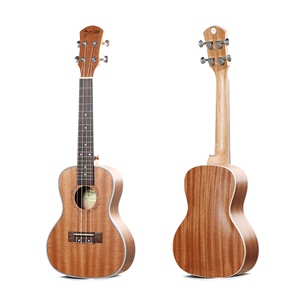
A. Quartersawn Mahogany & Sapele: The premier choice for institutional and educational orders. Mahogany imparts an articulate, focused midrange with warm overtones and excellent punch. Its structural stability makes it impervious to fluctuating handling environments. Sapele delivers a slightly brighter top end with attractive ribbon grain figuring, offering exceptional aesthetic appeal at an economical wholesale tier.
B. Solid Spruce Top with Engineered Rosewood Back/Sides: Engineered specifically for stage performance and recording artists. The solid Sitka or Engelmann spruce soundboard acts as an acoustic transducer, offering wide dynamic headroom and lightning-fast transient response. When paired with high-density laminated rosewood or walnut backs, the instrument achieves orchestral projection with rich, piano-like bass fundamentals.
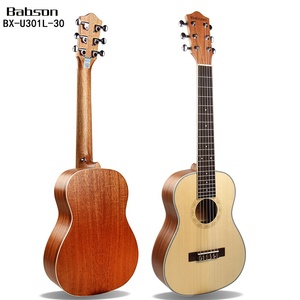
C. The 6-String Baritone Guitarlele Hybrid: A rapidly expanding category across retail channels. Merging the compact 30-inch profile of a baritone body with the six-string versatility of a standard guitar (tuned A-D-G-C-E-A or standard E-A-D-G-B-E), this hybrid model allows outdoor enthusiasts and touring musicians to travel without sacrificing chord familiarity.